Meadowscaping
It might just save your wallet, air quality and biodiversity along the way.

I learned about the particulate matter floating through my own neighborhood — microscopic particles of dust, soot, and chemicals so fine they bypass your body’s defenses and lodge deep in your lungs. The World Health Organization estimates they contribute to millions of premature deaths each year.
And here’s the part that stopped me mid-lawn-mow: my own yard was part of both the problem and the solution.
The lawn mower I pushed every weekend? A gas-powered mower emits as much pollution in one hour as driving a car for 100 miles. The grass I was so carefully maintaining? It turns out those manicured green carpets are almost useless at capturing the pollution drifting through my neighborhood.
But the meadow I let grow in my backyard? That wild, unruly patch that made my neighbor frown? It turns out it was quietly, efficiently, scrubbing the air clean.
And the science behind this is absolutely fascinating.
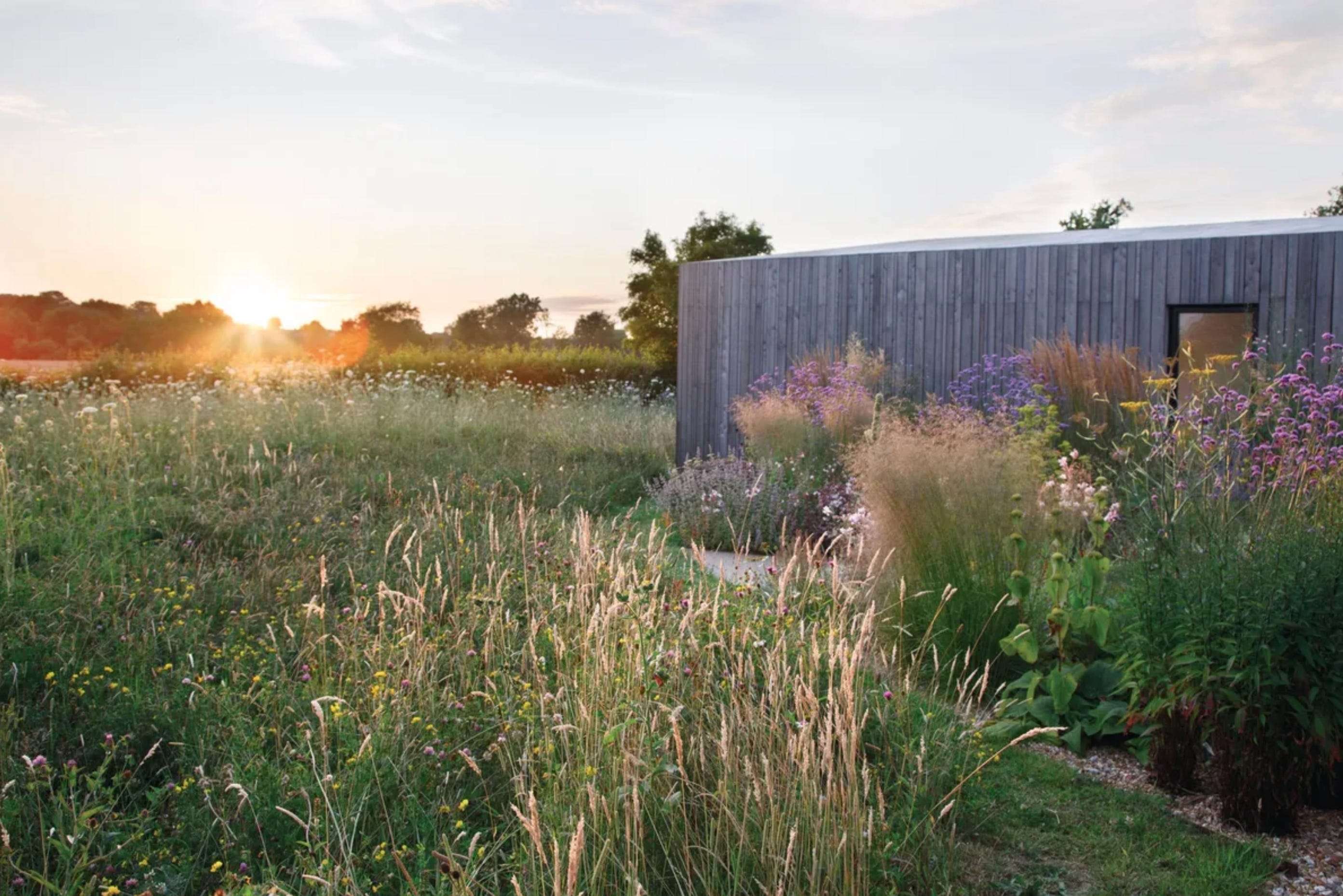
The Hidden Superpower of a Meadow
Let me introduce you to a concept you’ve probably never heard of: particulate matter accumulation. It’s a fancy term for something remarkably simple — plants are nature’s air filters. Their leaves capture airborne particles the way your furnace filter traps dust.
A 2021 study in the journal Science of the Total Environment compared how well traditional lawns and urban meadows capture particulate matter. The researchers measured PM accumulation on plants in annual meadows, perennial meadows, and conventional lawns. They expected some differences.
What they found surprised them.
“PM accumulation in one square metre of urban meadow was on average greater than that of lawn, regardless of meadow species’ composition, age and location.”
Think about that. One square meter of meadow — maybe the size of a yoga mat — consistently outperformed the same area of lawn at capturing pollution. Every time. Regardless of what was growing there. Regardless of whether it was brand new or years old.
The study concluded that meadows “could be an important element of nature-based solutions for mitigating air pollution in urbanised areas”.
In other words, your backyard isn’t just a backyard. It’s a pollution treatment facility.
Why Meadows Beat Lawns (It’s Not Even Close)
The researchers wanted to understand why meadows are so much better at capturing pollution. What they discovered is both intuitive and surprising.
Biomass matters. The single biggest factor determining how much pollution a plant can capture? How much plant there is. Meadows produce significantly more above-ground plant material than lawns do — more leaves, more stems, more surface area for pollution particles to stick to.
Structure matters. The way plants grow — their architecture, their density, their three-dimensional complexity — creates a much more effective filter than the flat, uniform surface of a lawn.
Species selection matters. Among the best performers in the study:
Yarrow (Achillea millefolium) — high PM accumulation
Viper’s bugloss (Echium vulgare) — consistently strong performance
Brown knapweed (Centaurea scabiosa) — top performer in perennial meadows
Field bindweed (Convolvulus arvensis) — surprisingly effective
The researchers also found something interesting about leaf characteristics. Feathery, finely divided leaves captured more pollution. Higher wax content on leaves helped, especially in annual meadows. But leaf hairs? Plant growth pattern? Leaf size? None of these had any measurable effect.
What matters is having more plant. And meadows simply have more plant.
The 94% Solution
But capturing pollution is only half the story. The other half is creating it.
Every time you fire up that gas-powered lawn mower, you’re not just cutting grass — you’re generating emissions. Lots of them. A gas mower produces in one hour the same volatile organic compound emissions as a car driven for 100 miles.
Now consider what happens when you stop mowing.
Hitachi Global Air Power recently converted seven acres of lawn at their Michigan City, Indiana headquarters into native prairie. The company crunched the numbers. Their projection?
A 94% reduction in lawn maintenance emissions.
Ninety-four percent.
They’re not alone. The University of Nebraska Medical Center replaced turf grass with native prairie plantings across their campus, explicitly citing the goal of “cutting emissions” through reduced mowing. In Helsinki, researchers studying eight lawns and eight meadows found that converting lawns to meadows created measurable reductions in maintenance-related carbon emissions.
Every time you skip a mow, you’re not just saving your Saturday morning. You’re preventing a measurable amount of pollution from entering the atmosphere.
The Carbon Question (It’s Complicated)
Here’s where things get interesting — and a bit nuanced.
When researchers in Finland measured the actual carbon exchange of lawns versus meadows, they found something that seems contradictory at first: the studied lawns were stronger carbon sinks than the meadows.
Wait, what? Does that mean lawns are actually better for the climate?
Not so fast.
The researchers themselves note that their findings were “uncertain” because urban soils are rarely in equilibrium — they’ve been disturbed, compacted, and modified by years of human activity. Moreover, the deeper story matters more.
Lawns require constant inputs. Fertilizers. Water. Fuel for mowing. All of these have carbon footprints that weren’t fully captured in the soil measurements.
Meadows build deeper carbon stores over time. The University of Nebraska Medical Center specifically notes that prairie grasses “have more extensive root systems than turf grass and can store more carbon in the soil”. Bob Vila’s reporting on meadowscaping similarly emphasizes that “the extensive root systems of native plants and grasses have the potential to sequester more carbon over time than lawn grass”.
The long game matters. A meadow’s root system can extend 10–15 feet into the soil. Turf grass roots go maybe 4–6 inches. That’s not just a difference in depth — it’s a difference in permanent carbon storage capacity.
And here’s the part the Finland study acknowledges directly: “the mesic meadow was more resistant to drought events than the non-irrigated lawn”. A lawn that dies in drought isn’t sequestering anything. A meadow that thrives is.
The Truth About Trees
Before we go further, let me address something that might be on your mind. I’ve heard people say: “If you really care about air pollution, why not just plant trees? They’re bigger. They must be better.”
This is where the science gets genuinely fascinating — and where urban meadows have a secret advantage.
A major study from the University of Edinburgh used atmospheric chemistry and transport modeling to quantify how much pollution vegetation actually removes from the air. Their findings:
UK vegetation as a whole reduces PM2.5 by about 10%
Urban vegetation specifically reduces urban PM2.5 by only about 1%
Even converting half of all open urban greenspace to forest would reduce urban PM2.5 by only another 1%
Why such modest numbers? Because urban pollution sources — cars, industry, construction — are concentrated where people are. And trees often can’t be planted exactly where they’re needed most.
But meadows can.
Unlike trees, meadows don’t need deep soil. They don’t drop branches on cars. They don’t block sight lines or interfere with power lines. They can be planted right next to roads — the very source of the pollution.
That roadside strip between the sidewalk and the street? Perfect for a mini-meadow. The slope where trees can’t take root? Ideal meadow habitat. The utility easement where trees are prohibited? Meadows are welcome.
Meadows go where trees cannot.
Species Matter: Which Plants Are the Pollution-Scrubbing Champions
If you’re ready to turn your yard into an air-purifying powerhouse, not all plants are equal. The research has identified clear winners.
From the Science of the Total Environment study:
For annual meadows (planted fresh each year):
Yarrow (Achillea millefolium) — top performer
Lambsquarters (Chenopodium album) — excellent accumulation
Viper’s bugloss (Echium vulgare) — consistent across studies
For perennial meadows (come back year after year):
Brown knapweed (Centaurea scabiosa) — highest accumulation
Viper’s bugloss (Echium vulgare) — strong performer in both contexts
Field bindweed (Convolvulus arvensis) — surprisingly effective
A Mexican study from 2024 evaluated six species for their ability to capture particulate matter and found that Sedum reflexum had the highest retention capacity — a succulent that’s already popular in green roofs and xeriscaping. The same study identified lavender (Lavandula angustifolia) as another strong performer.
Research from Rome on vertical greening systems found that Centranthus ruber (red valerian) exhibited the highest overall PM capture efficiency among native species tested. Smaller particles — the kind most dangerous to human lungs — were best captured by Cymbalaria muralis and Capparis spinosa.
What this means for you: a diverse meadow with multiple species is likely your best bet. Different plants capture different particle sizes. More species means more complete coverage.
The Numbers Don’t Lie
Let me put this all together with some actual figures.
Pollution ImpactTraditional LawnNative MeadowPM capture per m²BaselineSignificantly higher (exact multiple varies)Mowing emissions100%94% reduction possibleWater neededHigh (irrigation typically required)Minimal (native plants adapted to local rainfall)Carbon sequestrationShallow roots, limited storageDeep roots, greater potentialFertilizer/chemical inputsRegularNone
The Hitachi project’s 94% emission reduction is striking, but it’s not the only data point. The University of Nebraska Medical Center explicitly cites “cutting emissions” as a core goal of their prairie conversions. The Helsinki study measured greenhouse gas fluxes across multiple sites and confirmed that conversion doesn’t increase methane or nitrous oxide emissions — the two most potent greenhouse gases.
Every mow you skip is a measurable reduction in your personal carbon footprint.
The Practical Guide: How to Build Your Air-Purifying Meadow
Ready to turn your yard into a pollution-scrubbing machine? Here’s what you need to know.
Start Small
“You don’t have to convert your entire lawn at once,” says Julie Weisenhorn, horticulture educator at the University of Minnesota Extension. “A lot of people will become overwhelmed by ripping out their entire front yard.” Instead, she recommends starting with a small area — maybe that hard-to-mow slope, the strip by the sidewalk, or a border around the patio.
Prepare Your Site
Here’s something crucial that surprises most people: you can’t just scatter wildflower seeds on your lawn and walk away. The existing grass will outcompete them for sun, water, and nutrients.
Instead, you need to start with a clean slate:
Sheet mulching: Cover the area with cardboard or several layers of newspaper, top with compost and mulch, and let it sit for a season. The grass dies; the soil improves.
Sod removal: Cut out the existing turf and dispose of it.
Smothering: Cover the area with black plastic for several months during the growing season.
Choose Native Species
This is non-negotiable. “It’s important to go native,” both Brewer and Weisenhorn stress. “Native plants are more resilient to stress from extreme weather and variability from climate change. Natives also do a better job supporting pollinators than exotic plants.”
Avoid “meadow in a can” wildflower mixes. They often contain fast-blooming annuals that provide a short burst of color but can’t stand up to weeds, plus non-native and potentially invasive species.
Aim for 60/40
Bob Vila’s landscaping experts recommend about 60% grasses or sedges and 40% flowering plants. The grasses form the backbone of your meadow, providing structure and ground cover. The flowers add color, support pollinators, and — as the research shows — capture pollution.
Give It Three Years
The Pennsylvania Department of Conservation and Natural Resources has a saying about meadow establishment:
Year 1: It sleeps.
Year 2: It creeps.
Year 3: It leaps.
That first year, your meadow might look underwhelming. Maybe even weedy. This is normal. The plants are establishing root systems — those deep, carbon-sequestering, water-absorbing roots. The second year, you’ll see more growth. By the third year, your meadow will explode into its full glory.
Maintain Mindfully
Meadows aren’t no-maintenance. They’re just less maintenance than lawns.
First two years: Keep weeds under control. For seeded meadows, mow occasionally to prevent weeds from taking over. For planted meadows, hand-weed and mulch.
Established meadows: Cut and rake away dead vegetation each spring. That’s it.
Never fertilize: Native plants don’t need it, and fertilizer just encourages the plants you don’t want.
Water during establishment: Once established, native plants typically don’t need supplemental watering except in severe drought.
What About the Neighbors?
Let’s be honest: this is the part that stops most people. The lawn is a cultural institution. A meadow can look… different.
Becky Klukas Brewer, director of Prairie Moon Nursery, has a simple solution: get a sign.
For the first few years, use a temporary sign that says “Meadow in Progress.” When the meadow is established, replace it with a metal sign identifying your yard as a native wildflower meadow. Brewer says this simple step changes how people interpret what they see. A meadow without a sign looks neglected. A meadow with a sign looks intentional.
Other tips for keeping the peace:
Create clear borders with mown edges, stone paths, or traditional landscaping
Keep plants trimmed around the edges to maintain a tidy appearance
Talk to neighbors before you start — let them know what you’re doing and why
Check local regulations. Some municipalities have height restrictions for vegetation
The Bigger Picture
Here’s what I keep coming back to.
The average American lawn requires 10,000 gallons of water per household per year just to stay green. It demands fertilizer that runs off into waterways, creating algal blooms and dead zones. It consumes fossil fuels for mowing, edging, and blowing. It provides almost nothing to the ecosystem around it.
And when it comes to the air we breathe? It’s basically neutral. It doesn’t help. It might even hurt.
Meanwhile, the meadow you plant instead:
Captures particulate matter from the air, especially in the roadside locations where pollution is worst
Reduces mowing emissions by up to 94%
Sequesters carbon in deep root systems
Filters stormwater and reduces runoff
Creates habitat for pollinators and birds
Builds soil health over time
Provides a healing, restorative environment
All while asking almost nothing of you.
Where to Start Tomorrow
If you’re ready to join the meadowscaping movement, here’s your action plan:
This week: Identify one small area of your yard to convert. The strip by the sidewalk is ideal — it’s where pollution is worst and where your meadow will do the most good.
This month: Research native plants for your region. The Lady Bird Johnson Wildflower Center’s website lets you search by state and growing conditions. Find a local native plant nursery — big box stores rarely carry true native species.
This season: Prepare your site. Sheet mulch or remove turf from your chosen area. If you’re doing a larger conversion, start small and expand.
Next spring: Plant your meadow. Choose 3–5 native species to start with — too much variety at once can be overwhelming. Water during establishment. Watch it grow.
In three years: Enjoy your thriving, air-purifying, pollinator-supporting, neighbor-impressing meadow.
The Quiet Revolution
I think about the Hitachi headquarters in Michigan City sometimes. Seven acres of lawn, converted to prairie. A 94% reduction in emissions. That’s not nothing. That’s a measurable contribution to the air their employees breathe, their neighbors breathe, their community breathes.
The University of Nebraska Medical Center calls their urban prairies a “restorative environment that can reduce stress”. They talk about connecting city dwellers to a landscape that once covered most of the continent — an ecosystem now reduced to 1% of its original range.
This is bigger than just air pollution. It’s about reimagining our relationship with the land under our feet. It’s about recognizing that the spaces we maintain aren’t just decorative. They’re infrastructure. They’re habitat. They’re lungs.
And they can be so much more than we’ve been asking them to be.
P.S. — If you’re reading this and thinking “I’m ready to start, but I need specific plant recommendations for my region,” drop a comment. Tell me where you are and what you’re working with. I’ll point you toward the native plant resources that can help. We’re building something here — one yard at a time.
---
**Sources cited:**
- Science of the Total Environment (2021): “Where trees cannot grow – Particulate matter accumulation by urban meadows”
- Helsinki study on lawns and meadows (2024)
- Hitachi Global Air Power prairie conversion (2025)
- Better Homes & Gardens meadowscaping guide (2023)
- Bob Vila meadowscaping guide
- University of Nebraska Medical Center urban prairies (2021)
- University of Edinburgh air pollution mitigation study (2020)
- Monterrey, Mexico PM capture study (2024)
- Rome vertical greening systems study (2025)
*Enjoyed this? Subscribe for more stories about living lighter on the land. No spam, just the occasional meadow update and practical guides to joining the revolution.*